


This time last year, we announced the launch of the Queen Mary and Barts Health Tuberculosis Centre. This is a new centre of excellence where clinical specialists, researchers and local advocates are joining forces to tackle tuberculosis in East London.
East London has the highest rate of newly diagnosed cases of TB in Western Europe. The Centre was established to help meet the rising need for improved healthcare and scientific research – all thanks to our commitment of investing £4.63m.
Since it opened, teams at the centre have been working tirelessly to bring these changes into effect. Here are just some of the ways they are transforming TB outcomes for patients in East London:
An easier way to diagnose TB
Adult patients with suspected TB, who cannot provide a sputum sample, often need to have a bronchoscopy, in which a thin tube is inserted into the lungs via the nose or mouth. This is invasive and often distressing.
Sputum induction is a great alternative method. The patient breathes in a ‘mist’ of fine droplets of salty water, which helps them to cough – so they can provide a sample without needing a bronchoscopy. It’s safer, less invasive, cheaper and just as accurate as a bronchoscopy. To help make this procedure available to more patients who need it, the centre has installed negative pressure sputum induction tents in Barts Health outpatient clinics.
The addition of these tents will allow the service to be offered for both adult and child patients within Barts Health hospitals. It’s an important tool for diagnosing lung TB that offers a much quicker turnaround time for results. This in turn will free up the bronchoscopy suite for adult patients who truly need this investigation (e.g. for suspected lung cancer) and allow more patients to access a quicker diagnosis.
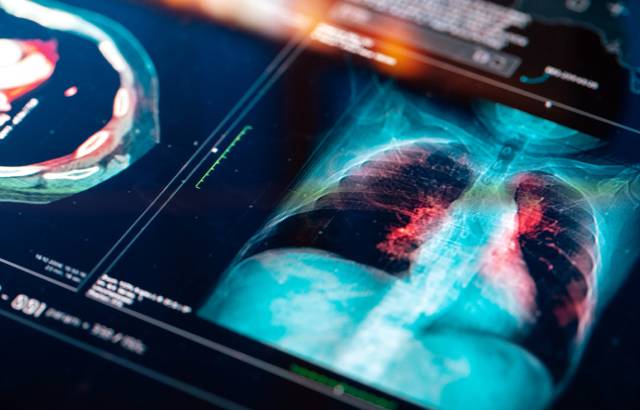
An x-ray of a patient's lung
A speedier diagnosis
Currently, to detect Mtb (the bacteria that causes TB) in sputum samples, microscopy or culture tests need to be ordered, which can cause significant delays. To reduce this delay, GeneXpert systems have been installed at Barts Health TB clinics. These will instead offer point of care testing and a much speedier turnaround of just two hours. This will be instrumental in speeding up diagnosis and initiating treatment. These machine can even identify drug-resistant TB, allowing affected patients to start taking appropriate treatment straight away.
Follow up care for TB patients
Up to half of lung TB survivors have some form of post-TB lung disease, impairing their exercise tolerance and quality of life. Up to 40% of patients treated for spinal TB cannot walk by their nine month follow up and 32% of those treated for TB meningitis have a residual form of physical disability. Despite these lasting adverse effects, the focus in TB healthcare has primarily been on diagnosis and completion of treatment.
In a world first, the team have established regular clinics for TB patients with TB meningitis and spinal TB. It offers support from a multidisciplinary team as well as follow up care for patients who have completed treatment but are suffering from long-term complications. This includes a one-to-one telephone peer support service.
They are currently in the process of onboarding patient advocates, who will be based in the post-TB clinics at Barts Health. These advocates will be on hand to provide practical advice on possible side effects and long-term consequences of TB, how to navigate the healthcare system and signpost to relevant support. They will also provide a listening ear, to reduce isolation and tackle stigma.
“We have TBAG [TB Action Group] members who have experienced everything from a kidney transplant (renal TB) to becoming registered blind (due to TB/HIV meds), psychosis (from TB meds), and someone who had to relearn how to walk after TB meningitis. It’s been my dream to have a service just like this.”A TB Action Group and PPIE board member
Putting patient voices front and centre
Amy McConville and Patience Renias-Zuva are TB survivors and co-leads of the Centre for TB’s Patient and Public Involvement (PPIE) group. Since last year’s launch, Amy and Patience have established a diverse panel of members with lived experience of TB. They have been instrumental in shaping new service innovations and provide informed guidance on research projects.
The PPIE board have also played a crucial part in the recruitment of patient advocates.
“This role is very personal for me because I had TB as a teenager living in Zimbabwe. It’s amazing to be involved with the PPIE panel and it’s so inspiring to see the work being done. The panel is quite international, so not only do we get the perspective of people living here, but also of those who come from high incidence settings.”Patience Renias-Zuva, co-lead of the PPIE panel
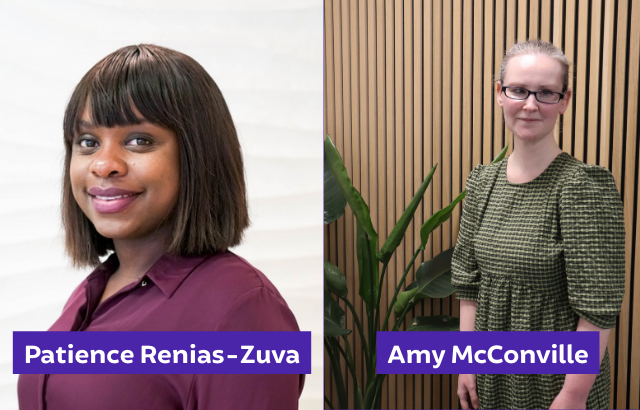
Patience and Amy are the co-leads of the Centre for TB's PPIE group.
Advocacy in East London and beyond
In addition to her work with the PPIE panel, Amy has been busy working with community organisations to help raise awareness of TB. She has collaborated with Social Action for Health, Positive East, NTB and other advocacy groups to strengthen community links, especially within the Bangladeshi community.
Amy has also given evidence as an expert witness to the All Party Parliamentary Group Global TB enquiry, campaigning for improved policies on TB healthcare and how to tackle the growing epidemic.
Improving our understanding of TB
The centre focuses on TB research around the below themes:
- Identifying factors that influences susceptibility to TB in people of Bangladeshi and Pakistani ancestry living in East London. These factors are currently poorly understood, and research in this area could lead the way to developing tailored treatments for these communities.
- Improving the accuracy, turnaround time and cost-effectiveness of diagnostic tools.
- Improving scientific understanding of common complications of treatment.
Through clinical innovation and research done in collaboration with the community, the centre will not only improve how we understand and treat TB in East London but could also make meaningful change around the world.